Age Matters…or Not?

Seven Ways Growing Older Changes Christian Radio Listener Reasons for Listening

We shared the top reasons for listening to Christian radio by age in the March Finney Fast Five. If you take a close look, you’ll see ways that your listener changes through the years, as well as some significant ways she remains the same.

Recently, we read an author review in the Wall Street Journal Weekend edition that discussed how author Richard Holmes felt the need to “physically pursue his subject through the past…must go to all the places where the subject had ever lived or worked, or travelled or dreamed. Not just the birthplace…but the temporary places”. This seems to us an extraordinary effort to fully understand someone else’s perspective, challenges, joys and pain. Our hope is that research can help with this effort—although we would certainly encourage specific efforts to see through your listener’s eyes.

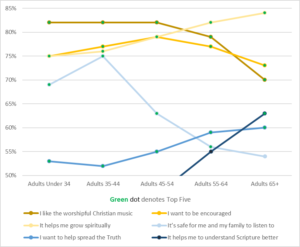
Age is something that each of us has no control over, and it factors into our views, the way we approach life and the reasons we do things. We see the changes clearly in the Finney Media Why Listen?™ national survey data, when we sort the top ten reasons for listening to Christian radio.  This graph illustrates the changes.

Within the top ten reasons for listening to Christian radio, we observe that “I want to help spread the truth” gradually increases through the years. “It helps me to understand the Scriptures” also sees a gradual increase.

Showing up at around 55 is “it gives me a Christian perspective on the news” and even later, at around 65, “I want to hear the sermons”.

There is a reason that gradually drops as well. “I want to get away from negative messages or music on There is a reason that gradually drops as well. “I want to get away from negative messages or music on other stations” gradually drops through the years.

What is perhaps even more notable than the ways your listener changes with age, is the ways she stays the same.

While the top three reasons for listening to you may shift around in order, these three reasons consistently remain the top three reasons Christian radio listeners listen: 1. I like the worshipful Christian music. 2. I want to be encouraged. 3. It helps me grow spiritually.

And notably, up to age 55, the top five reasons remain the same. Adding to the reasons just mentioned are: 4. I want to get away from Negativity. And 5. It’s safe for me and my family to listen to.

It’s in the mid-fifties that other reasons break the top five. “I want to help spread the truth” moves up, and then at 65, “It helps me to understand the Scripture” moves up to number four.

You can see these changes in the accompanying graph.

What’s going on here? Life’s journey, with the changes in children’s lives, sickness, divorce, job change or not, death, physical ageing and spiritual growth, moving homes or communities or careers begin to influence our views on what’s truly important and on the shortness of life. No wonder through it all we hunger for encouragement and spiritual growth fueled by worship.

As Jan’s grandmother said as she approached the end of life, “It goes so fast. It just goes so fast.”

Our listener walks along the road of life—though often in her car—and needs you as her encouraging companion, revealing what’s worshipful, true and Biblical. That’s the panorama, the picture we see forming as we look at reasons listeners listen to Christian radio, sorted by age.


Before Heart Connection

Affirmation Counts


Heart connection. It’s our goal as we communicate.

When we observe and understand that goal, our friends, our family, and yes, our listener will be impacted and will see life change and spiritual growth. We can’t help but want to create this connection.

Chuck tells of a question put to him recently: “Chuck, how can I coach my team if I don’t have enough hours in the day?” In other words, how can I see impact and growth with someone I’m around daily without spending exhaustive amounts of time and effort? How can I communicate efficiently and effectively?

Here’s an idea: catch this person doing something right. Affirm them. It only takes a minute.

Catch the morning host in the hallway and say, “The break you did at 7:35 about (topic) was awesome!”

See the admin at the front desk and say “The smile in your voice is the best public relations ever!”

Say to your board president, “That explanation of rates was eye-opening and saved my bacon. Your insight was a life-saver!”

Say to your listener, “You are the one that brings a smile to my face today! Your interest, the warmth in your heart and your desire for God makes we want to get up early and talk to you today!”

No “buts.” Just the positive. And see what a difference a little extra affirmation makes in the people around you.

A post-NRB note:  We listened to Shaunti Feldhahn speak to radio broadcasters about The Thirty Day Kindness Challenge.  Doesn’t this sound like a way to jump-start affirmation?

Why the Finney Media Why Listen?™ survey?

We believe the time to reach more hearts more deeply with the gospel is now.  We believe asking listeners why they listen to Christian radio and really listening to and acting on their answers is so much better than guessing!


The Finney Media Why Listen?™ 2018 survey is one we’ve done nationwide in 2016.  We surveyed nearly 23,500 respondents—all listeners to Christian radio formats. Listener feedback has been sorted in many different and helpful ways.

The results were profound! Next year in 2018 we’ll ask some new questions, some even deeper questions and some vital repeat questions for benchmark comparisons.

We invite you to join us. It’s low cost—and with additional special pricing for NRB members, CMB members and Advocace clients.

Join us HERE!  Get equipped to better serve your listener in 2018!

Finney Media Why LIsten


How to begin your successful campaign


The majority of our clients are “expecting” this year. And you may be one of them!  Decision makers from radio stations, broadcasting networks and nationally syndicated shows are huddled into conference rooms, alive with the hope that their radio campaign ideas for the year will be successful.


Some people bring ideas scrawled across post-it notes, cell phones, pads and napkins. Others have the entire campaign mapped out in bullet points complete with a timeline, budget and projected outcomes. Wherever you fall on that spectrum, you know it’s tough to come up with a campaign that listeners won’t just ignore or tune away from.


Foundations for a Top Flight Campaign


From helping victims of tsunamis to feeding the hungry to church building funds, Christians are bombarded with well-meaning campaigns designed to tug at our heartstrings and provide opportunities for sacrificial giving. With that as a motivator, here are eight essentials to consider BEFORE you get the campaign ball rolling:


  1. Prayer. Of all the ideas vying for attention, nothing good can germinate without love and God’s blessing. Ideas need to be brought together and prayed over. Thought about. Tossed about. Blended and prayed over with persistence.


  1.  Love. A great campaign doesn’t necessarily generate the most ideas/money/kudos/paperwork. It generates love. Its message is backed by love. Its response is love. If love can’t be extracted from your idea and brought to the forefront, it probably won’t directly impact your listener.


  1. Decency and Order.  Consider how God creates. With time and with love, with uniqueness in mind, decently and in order. Don’t let deadlines, initiatives and other perceived pressures get in the way. A great campaign is a living thing that, when executed in God’s timing, will remain evergreen.


  1. Money. We’ve found that generally it takes a minimum of 18 campaign ads per week to deliver an adequate, memorable repetition that produces measurable results. The number can vary with specific circumstances, or with the type of campaign.


  1. Time. Begin planning a major campaign at least six months before you launch.Don’t be a ministry whose calendar becomes glutted with a number of initiatives to be launched “ASAP”  with no budget set aside, no time to create great messaging, and no permission from management to revise worn copy.  Don’t be stuck in a rut, but pressured to “keep generating new projects.”


  1. Great messaging. There is such a thing as constituent resistance. With all the “gimme-gimme” messaging trying to capture our attention, listeners have learned how to say “no” before they’ve even heard the offer! Try offering an educational tidbit, an emotional story or a REAL solution to an immediate need or problem. The interaction between the listener and the call to action needs to contain an immediate benefit or your campaign will be ignored.


  1. Keep it simple.  A confused mind does nothing. Create your campaign in small stages rather than trying to cover it all in one ad. Build layers. Develop the relationship. Be creative! We all love a good movie where the plot is revealed cleverly over time. Make it fun–make it a series! Don’t expect your listener to jump into a giving relationship with you at the word go.


  1. Patience. How long does it take you to decide to give to a new charity? A year? Allow your listeners the same amount of breathing room. Create urgency, but cultivate patience. Rule of thumb is to wait 52-weeks before calculating the results. Think of how patient God is with you and apply that to your beloved listener. Allow them to transform from passive listener to collaborator.


MOVING PAST THE RESULTS

We recently posted the reasons listeners aren’t giving to a radio station or network HERE.  The bottom line is–even though they love your station or ministry, they’re primarily not giving because they can’t afford it. We certainly don’t want to squeeze money out of those who can’t afford it, but we do want to ask God how to be good stewards of air time, talent, listener funds and His Word so that your station or ministry can keep sharing uplifting music and inspirational messages that change lives.

How long does it take you to decide to give to a new charity? A year? Allow your listeners the same amount of breathing room. Create urgency, but cultivate patience. Rule of thumb is to wait 52-weeks before calculating the results.

Think of how patient God is with you and apply that to your beloved listener. Allow them to transform from passive listener to collaborator.


Your words create change

Jan here.

While I was reading Tim Keller’s book Prayer, this comment arrested my attention: “Speech act theory makes a convincing case that our words not only convey information, they get things done. However, God’s words have a power infinitely beyond our own.” Keller goes on to point out examples of God’s word being the “effect.” Let there be light = light. “…what God’s voice does, God does.”

We don’t have that enormous power with our words. However, speech act theory says that we do have great power to get things done. Numerous sayings reflect this truth. Sayings such as, “A simple sentence spoken at the right time could change someone’s life forever.” Or, “One kind word can change someone’s entire day.”

James in the New Testament reflects on this when he writes, “So also the tongue is a small part of the body, and yet it boasts of great things.  Behold, how great a forest is set aflame by such a small fire!” (James 3:5)

All this gives us reason to pause when we think of the number of words that flow from our radio station talent, our ministry programs and our own mouths.

James, again: “From the same mouth come both blessing and cursing.  My brethren, these things ought not to be.” Wow, that’s blunt!

We know that people come to us for encouragement, for spiritual growth and to be calmed. Personal systems and daily habits, done in the power and presence of the Holy Spirit, can move us toward “tongue containment,” using our tongues to bless, heal and encourage and helping us create a warm on-air environment.

Here’s a few possibilities:

  1. Read through the Psalms, a set number of verses or a set amount of time per day. Even five minutes in the morning speeds our spiritual growth and develops a blessing attitude. Doing this with an audio Bible has the same effect. There’s a little book, now out of print but still available on Amazon, called 31 Days of Wisdom and Praise that breaks out the Psalms and Proverbs into 31 readings. I highly recommend it.
  2. Write down one thing you are grateful for after reading Psalms. Just one. And write it on a slip of paper or sticky note to look at during the day.
  3. Create one of your passwords to include a blessing phrase—you’ll need to add some other characters to keep it strong—but the core of the password will smile at you whenever you type it. For example, Jesusyoubringjoy!@#Today!*&^7102
  4. Listen to your station or program at a different time each day, scheduled on your calendar.

When you are encouraged, your words will flow from habit and the heart to change someone’s day—or life. That’s word power! Together, let’s start today.


How God Worked

Chuck here.

I could not see it at the time, but God was preparing me for the work He made me for, helping Christian broadcasters reach more people, more deeply.  As is said in Ephesians in the Bible, chapter 1, “he chose us in advance, and he makes everything work out according to his plan.”  It’s a profound truth, one that causes me to shake my head in wonder.

God had His plans…

. . . when He had my dad work in radio so I was around it at a young age . . . with a studio in our basement.

. . . when He led me to the 10 watt mono FM college radio station.

. . . when my first part time radio job was working for one of the smartest radio guys in the business.

. . . when my next part time job was working for one of the pioneers of music research in radio.

. . . when He let me to see, endure and learn from the politics and crazy cultures at radio stations.

. . . when He allowed me to learn, by making just about every mistake someone can make working in a radio station.

. . . when He surrounded me with believers in secular radio (crazy, right?), to nudge me back to him so that I would commit my life and work to Him…so I would lean on Christ and learn to abide in Him.  (John 15:5)

. . . when He put the right people in the right places to lead me into Christian radio.

. . . when He taught me that true submission to authority is doing it when it’s hard, not when it’s easy.

. . . when He led me to working with NCRS, Christian Music Broadcasters, National Religious Broadcasters . . . and amazing friendships the gifted people who make those organizations fly.

. . . when He opened the doors to working with our amazing team at Finney Media. Each of them a gem of skills, life experience and focus on magnifying His name.

I couldn’t see it then. And isn’t that the point? So that we can be thankful for what looked at the time like coincidences, but in fact were God’s hand and plan . . . so that I can do the work He made me for.

 What’s your story?  How has God intersected events in your life with His profound grace and plan?

Truth in a Window


 Chartres Cathedral is about 75 miles southwest of Paris, in a little town called Chartres. The cathedral dominates the town.  I visited there awhile back, and frankly, I’ve been thinking about it ever since.  Why? The long-gone folks who built this incredible building knew how to communicate with story—I got the messages even hundreds of years later. And it made me wonder about what we do on-air every day.

Our guide to the cathedral explained that it was built to be not just be a place of worship for the people who lived in the area, but it was also a story, a place that families could go to teach their children about God. Back during the building of it about 800 years ago, most folks couldn’t read, and if they could it was Latin, not for the common person. What a barrier to understanding!  Just close your eyes and imagine it.

So what the craftsmen did was build stories into architecture—the doorways, the sculptures and especially the stain glass windows. This particular cathedral has more stained glass than any cathedral in the world. In fact, it’s so valuable that during WW2 people who cared took it down and stored it away knowing there was a good chance it might wind up broken.

What might one of the stories be in one of these magnificent windows?  One I saw had the bottom half as the story of the Good Samaritan, while the top half was Adam and Eve. A sermon might connect these two stories. For example, they might tie in the Inn as a place of refuge in the Good Samaritan.

There are hundreds of these at Chartres. Yes, literally hundreds of pictures that attempt to make the profound story of God’s love clear to people who couldn’t read but needed to understand as much as any of us or any of our listeners.

Didn’t the Apostle Paul provide an example of this when he spoke at Mars Hill, and referenced various objects and inscriptions found in the Areopagus?  He spoke about things his audience was familiar with and understood. See Acts chapter 17 in whatever Bible version you prefer.

What is important today as we communicate the message of faith is the very same principle. Make the truth understandable. It is our responsibility to do so—not the audience responsibility to parse what we are saying to try to excavate the truth. Ask yourself if what you are doing is “flying over people’s heads”.  Or is the message clear enough to create heart change?

The craftsmen of Chartres, the apostle Paul…now it’s our turn.


Four Tips for Finding and Storing Heart-Connective Words, Phrases and Ideas

Jan here.

We often remind you of your listener’s perspective: your listener comes to you to be encouraged, uplifted, and calmed.  Yet it remains as true as ever:  Taking action on knowledge is still the most difficult part of the process.

We’re here today with some practical tips on how to regularly locate (and then relocate) heart-connective material. John Maxwell, well-known leadership author, suggests that creating personal systems is the way this will fit into our busy lives (see his newest book, The 15 Invaluable Laws of Growth).

We agree with Maxwell, so here are four systems we suggest putting into place so that you can consistently give your listener what she wants.

Four Ways to Find and Keep Idea-Generating Heart-Connective Material

  1. Schedule a visit to a local bookstore at least one time a month. Put it on your calendar! This is a fun activity whether you are a big reader or not. Local bookstores today are centers for coffee, magazines, games and yes, even books.

Walk around the store and find the Christian Living section. Often devotional collections or daily reader books will be separated out so you can look at the front cover. See some that look like they have promising short, impactful content? Look them over. Commit to buy just one…just one…and then whip out your phone and take photos of any others that look promising for a future review. With a photo now stored, you won’t forget what struck you the first time you saw the book. And you’ll be able to locate the author and title. Follow through tip: when you find a good quote in a book, write the page number and topic inside the front cover (as long as you’ve already purchased it). That way it’s  quickly available to you when you want it.

And yes, we all use Amazon. It’s good for locating material if you have an idea of what you want, to see what others are saying and for a quick check on content. But there’s nothing like a physical bookstore to inspire ideas.

  1. Schedule 15 minutes every week on your calendar—just 15—the same day each week, to search the web for powerful audio comments by speakers you may have heard of or who currently air on your station. Find something great? Download or order it immediately and save that location however you like to organize—Evernote, Favorites. Whatever you use. It’s now available for you to listen to as you walk or run or ride your bike—whatever repetitive activity you engage in. Ironing, anyone?
  1. While at the bookstore (see point #1) buy discounted daily calendars in season. Look them over—there are a number that offer pithy, powerful, Scriptural, moving quotes. This is an easy way to daily consume potential material—you just pull off a calendar page every day and have another option presented to you. The tear sheets for the material worth saving can go in a file folder you start right now. Label it Quotes/Ideas.
  1. Keep a list in your Quotes/Ideas file—both physically and digitally—of web locations you’ve discovered or books you’ve heard of. Keep a sheet at the front of the paper folder to keep this consistently handy, or a designated digital sheet or note area where you keep digital locations.


You’re probably getting the idea by now. Ideas await everywhere. We just need to have a planned awareness system to locate them—one we schedule—and a method to retrieve the material again.

Note that we usually share media recommendations in our monthly newsletter. If you haven’t signed up yet, take 60 seconds and do that right now, on the upper right hand side of this page. Then pull out your calendar and put feet to these systems!


Net Promoter Score:  a Help, a Hindrance, a Happy Place?

Chuck and Jan here.

By now you’ve likely seen the overall Christian Radio Net Promoter Score (NPS): A 76 out of 100.  Higher than some incredibly popular companies such as Apple, Amazon and even Southwest Airlines. In case you missed it, here how the NPS is calculated. First survey respondents answer the following question in the Finney Media Why Listen? Survey:

How likely is it that you would recommend the station/program that sent you this survey to a friend or colleague?

Looking at the chart above, you will notice the formula: the percentage of folks answering 0 through 6 is subtracted from the percentage of those answering 9 and 10. It’s a tough formula! And Christian Radio comes in looking really good.

An important question has come up. It’s this: As a station or network, what should we do with this score? How shall I act with this knowledge? Let’s roll through a series of possibilities and then consider the next step.

  1. Look at the great score and use it as a reason to “coast.” We’re good!
  2. Use it in advertising. Hey everybody, we’re good!
  3. Keep it from the team, so they don’t slack off. Psst…we’re really, really good!

OK, some of the list is indeed tongue in cheek, but it’s clear that we don’t want to use our scores either as a point of pride, or as a reason to coast. No matter how high the score, it’s only one measure of our engagement with the audience—and we know too well what the Scripture says: Beware. Pride comes before a fall.

We suggest that a humble spirit of gratefulness for the opportunity to be a witness and faithful presence in our community is a good approach. We are one of God’s servants, His presence to help and encourage.

We might use the number as a baseline to measure changes when the Finney Media Why Listen? Survey is repeated in 2018. We might share this as a praise and encouragement to our teams: God is good! And we suggest keeping it handy for days when things don’t go as planned and we’re wondering why we ever got into this business anyway!

Bottom line: This single number does say a lot. It offers us a pat on the back to continue the sometimes hard, always challenging, and mission fulfilling work that pulls us out of bed each day. Let’s praise God and use it to spur each other on to fight the good fight.


 “You change my day, Christian Radio.”


Chuck and Jan here.


With a Net Promoter Score in the seventies—ahead of many popular organizations—we can confidently say your listener thinks highly of you.  What’s behind the number—the heart reason?


We gathered some first-person evidence to answer that question. We asked about 125 music radio listeners, mostly gals, “how does your station make you feel when you listen?”


The response wasn’t just positive. It was a resounding chorus: You make me happy.


Kathy sums up the feeling for this overwhelming—unaided—word choice: “strong and happy, bold and courageous.


Monica gets more detailed. “It [radio station] makes my day better.  There have been many mornings that I left for work having a bad morning.  And it never fails, the right song comes on and makes the day better.”  Roseanne adds, “One song can totally change [the] outcome of the day.”


Other words listeners used after “happy”, in order of use were: 1. Uplifting 2. Joyful 3. Calm/peaceful 4. Hopeful


Take that to your next prayer and planning session.


Pray for God’s continued work in opening hearts.  For wisdom as you work to change a day, an outcome, and yes, a life.


You have favor. Today is your day of opportunity.

Blog Info.