Watch the Video >>
Finney Media will host a Why Listen?® Survey webinar Tuesday, September 25 Noon Central, zeroing in on changes from the 2016 survey to the just released 2018 survey. Register HERE.
You are praying and pondering how to lead your ministry, station and network. And, you know your listener continues to change. You know we live in challenging times. And, you know your vision is to connect deeply with your listener—to be there to help them on life’s journey. It’s your Mission! Join Finney Media President Chuck Finney as he outlines the changes we see in Christian radio listeners since the 2016 Why Listen survey. With the 2018 survey now history, we can trace our listener’s feedback changes—dramatic changes in the past two years.
Chuck will remind us of where we were two years ago, and observe specific questions that produced nearly the same response, and key questions that highlight how your listener has adjusted to the atmosphere since 2016. Has your listener become less patient? More web focused? More demanding? Spiritually intense? More demanding on tone? More narrowly focused on what she wants as options grow?
He will zero in on what your listener wants from you now in 2018—what she wants you to plan to to spend your time strategizing and producing, to create, to air.
Register TODAY. It’s $59 for the first 75 webinar registrants, so register today. Save the Date. Tuesday, September 25TH at Noon Central.
This is an hour that your listener will thank you for setting aside. Grab your lunch, gather your team, and plan to attend!
In the Why Listen® 2018 Survey, we asked 26,800 people from four different formats – music stations, teaching/music stations, all-teaching stations, and teaching programs – about why they listened, what caused them to give and how they depended on their station for spiritual growth. But the survey also included questions about the person who was filling in the survey. Here’s a roundup of important information from the more than 16,000 who identified themselves as music format listeners.
Food for thought as you see your listener in your mind’s eye. How are you meeting her today?
Writing is a skill used in just about every industry. Whether you’re producing content for a program, writing for the company blog, or just sending an email, putting words together in a cohesive manner is an important ability to have. And few of us got English degrees. For some of us, the last time we attended a writing class was in high school—and if we were being honest, we didn’t pay much attention.
Fortunately for us, the internet is rife with tools to help us communicate at our best.
Here are a few of the ones we like and recommend:
Grammar and Style:
Word Tools:
Productivity Tools:
That’s quite a list—perhaps select one or two of these tools to use starting right now!
Let’s face it together.
Is your air talent is not getting coaching like you know they should? Is it your responsibility to make sure it gets done?
Maybe no one is saying anything. Because your boss probablythinksit’s happening.
The talent wants the coaching, but also feels that bringing it up is just asking for criticism.
You’re so busy that weeks and weeks pass by and it seems like days.
Maybe you don’t have confidence in your coaching ability. Maybe you think it’s the consultant’s job, or maybe you don’t have a consultant.
You can keep going like this and nothing will change. Or you can fix it. Right now.
Let’s fix it.
The first way we’ll fix it is by adjusting your expectations. If you think of coaching as a big commitment of time and energy, then as a busy PD it’s natural to avoid it. You think it’s a huge project or you do nothing. So let’s make it a smaller, less intimidating project.
Here are five simple things you can do right now and keep doing in just 45 minutes per week.
Agree that air talent coaching is super important and that you’ll do something about it.
Commit to making sure they WILL be coached regularly. Be confident that consistent, small engagement can make a big difference.
Guess what! Two steps are done and you’ve taken hardly any time! Now for the simple, practical 45-minute per week steps:
Write down things you like and why. Write down things you don’t like and why.
Now organize your observations into 3 lists of 2-4 points each:
List 1. Hugs – the stuff you liked and why
List 2. Grow – the stuff you think needs to change and improve, and why
List 3. Goals – a short summary of what to keep doing and what to improve in
This is another 15 minutes.
Start with a few true words about their value, strengths, and potential. Start positive because they’re nervous and convinced this is going to be about what they’re doing wrong. So show them what they’re doing right. Let them know you believe in them.
They are doing art, and artists need confidence.
Then go thru your Hugs, Grow, and Goals lists.
Sometimes use some audio to illustrate your points.
Major on the positive and let them hear and feel what they did right. Be blunt and brief about change and improvement, then finish with something positive.
In the email just summarize what you talked about from your Hugs, Grow, and Goals lists. The email is a reminder that reinforces your meeting. Keep it short and encouraging, yet straightforward about change and improvement.
Good things will happen from this 45 minute per week habit!
And that’s it. You are on your way.
Pssst…if this is still too much, call us about our Talent Coaches who will listen to you and then focus on your Talent.
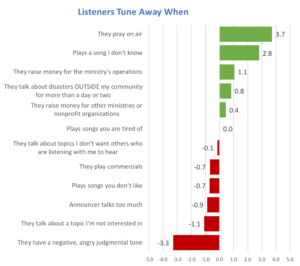
As we look at what you have on-air, there are detours that can send your listener away from your well-maintained radio or program highway. Respondents in the Finney Media Why Listen?(r) 2018survey rated twelve possible elements of radio programming that might make them want to tune away from a Christian radio station.
Here’s the way to read the graph below. The “tuneouts” at the top – the ones coded on green – are lower reasons for respondents leaving. The “tuneouts” at the bottom – the ones in red – are higher reasons for respondents leaving.

The road sign with the biggest flashing “DETOUR” warning sign hanging on a huge reflective barricade regards dealing with subjects in a harsh, negative, angry or judgmental tone. It’s good to know, however, that in response to a separate question, nearly nine in ten (89%) listeners said the “tone” of Christian radio programming theylisten to was extremely positive. Most stations and programs are not perceived as conveying a negative tone—but it is important to notice the big size of this flashing warning sign.
Announcers who talk about things I’m not interested in and announcers who talk too muchare tuneouts also. Taken to a further conclusion . . . announcers who talk too much about things the listener isn’t interested in are the deadly duo. Want them to leave? Meander on the air about things she’s not interested in. and music the listeners don’t like are the two major reasons they would tune away.
All of the music tuneouts are lower, but the data points to the importance of testing music to align with listeners’ tastes.
Reviewing these warning signs can save you from tune-out. Consider including these in discussion with staff or with focus groups.
The Why Listen?® 2018 Survey Total format results say this: The #1 main reason for listening to your program or radio station is because “It helps her worship God throughout the day”. And no matter the format, this reason falls in the top tier.
Worship is automatically associated with the one hour we attend church on Sunday—and that’s just one hour out of the 168 hours we have to spend each week.
Yet radio pervades our lives every day—that’s an opportunity seven days a week to help someone focus on our great God. Think about it–the worship band at church only has one half hour and the full service about one hour!
Jesus says, “You shall worship the Lord your God, and serve Him only.” Matthew 4:10
Most of us are bombarded by images of brokenness. A little girl stunned and traumatized. People worshiping false gods. Fake romance. War. Violence. Add to all this this the real-life curveballs of illnesses, accidents and angry people, and it’s easy to get lost in the hopelessness.
The daily discourse gets coarser, scarier and less edifying.
And yet. Think about it. This opens up our path to ministry—for us to turn hearts toward worship. Turning to God and honoring Him. A chance to help others focus their hearts and minds when “alone” with their thoughts—and their radio.
“Praise the Lord! Sing to the Lord a new song, and His praise in the congregation of the godly ones.” Psalm 149:1
Your work is seven days a week, helping an audience in hard times be daily worshippers. Minute-by-minute worshipers. Right now worshipers. Providing highly interesting/relational content to your listener, presented it in a way that is Biblically bold, spiritually encouraging and widely accessible.
We can help lift holy hands in an unholy world.
Seven day a week worshipping.
Creating Love at First Sight with your SEO Copy – The Final Chapter: Body Beautiful
In our SEO Blog Part One we talked about laying the groundwork for an SEO revamp. We talked about brainstorming, setting your station apart and developing stronger, more genuine traits. We discussed what it takes to get noticed. We encouraged you to clear the ground around you and create a niche that’s genuine and personal. In ourSEO Blog Part Two we explored the art of creating copy that is both persuasive and discoverable … words that help listeners feel like they’re being “cared for” rather than “catered to”.
THE FINAL CHAPTER: SEO META DESCRIPTION & COPY
Now we begin the final chapter. You’ve laid the foundation and created a fabulous title. Now you’re ready to create the meta-description and body … inviting and greeting hungry sheep who are seeking new pastures, and causing them fall in love with your webpage.
START WITH WHAT YOU PROMISED, NOT WITH CONFUSION
Notice we said your webpage. They don’t want pop-up windows or ads which interrupt their thought-flow and hostage their CPU’s. Confused and frustrated people won’t stick around. They won’t come back and they won’t tune in. They’ve read your headline promising green grass. When they click on your website, what do they seek? GREEN GRASS.
They want what you’ve promised. So meet their expectations, right off the bat. Match your landing copy to your ad copy. It’s friendlier to search engines, and it’s more cohesive to your seeker. If your headline says “24-7 Commercial-Free Christian Radio. All Your Favorite Music, Worship and Hymns”, then your webpage should greet them with “Welcome to Commercial-Free Christian Radio! Your Favorite Music, Worship and Hymns, 24-7.”That way, your visitors know they’ve entered the right house. If your welcome copy doesn’t match your headlines, there’s a disconnect. People click, expecting to find one thing. Instead they find another.
God is not the author of confusion. “For God is not a God of confusion but of peace. As in all the churches of the saints …” 1 Corinthians 14:33
MUTUAL AGREEMENT – SHAKE HANDS
Your audience should internally agree (resonate) with everything you write in this initial greeting. Good copy will steer and guide your reader’s focus down to the desired result. Their desires then become harmonious with the very thing you want them to do.
Think of it as a funnel. You start with the wide, broad attraction, funnel the focus into what you promised, deliver the promise, and then require them to make their move. The “move” should be simple. In other words, a simple submit-email-and-click gives them access to you for free.
There should be a FREE. Even if the subscription is only free for one month, it should be free. Emotionally, both teaching and music are associated with freedom … freedom from despair and freedom from sin. People love the word FREE; they love the idea of being FREE, so feel free to use it!
STOP THEM IN THEIR TRACKS
Here are some important tips when creating heart-stopping Meta description and body:
TECHNICAL STUFF
There are many, many aspects to SEO writing. It is a marriage between the creative and the technical … with a little strategy thrown in.
Here are technical bullet points to consider:
SUMMER LOVE: FALL IN LOVE WITH WORDS
There is untold power in human language. It’s so powerful in fact, that God Himself had to step in and confuse our language at the Tower of Babel. Otherwise, as He observed in Genesis 11:6, there would be no limit to what we as humans could accomplish.
Now we speak different languages. There are barriers. But if your goal is to unselfishly spread His hope, joy, knowledge and peace to a lost and dying world, He will guide you to get your message across.
In the end, you have to be in love with words. You have to love shuffling them around. When creating effective copy, make sure your heart is one of joy, curiosity and awe.
May more and more people fall in love with your webpage, your station, and with Jesus Christ!
A Microsoft Word license comes as standard issue on many company computers these days, so chances are good it’s your go-to software for writing copy.
Whether you’re new to the software or you’ve been using it for a while, here are a few tips and reminders to save you some time as you write.
When you click on “Share” on the File tab, the first option you’ll see is “Share with people.” This option allows you to give other individuals permission to either view or edit your document, depending on the permission you give them. This is not a stagnant copy—they are able to see the document that you have saved in your files, so they’ll be able to see any changes you make to it in the future. Only the individuals you give permission to will be able to access the document; any individuals they forward their document access links to won’t be able to access it.
The next option, “Email,” opens another world of options for sending the document. The first one, “Send as an attachment,” lets you send a stagnant copy of the document as an email attachment through Outlook. This is a separate copy from what you have saved in your files, so the individual you send it to will be able to see the document only as it looks at the point in time you send it. If you want them to see any changes you make to it in the future, you will need to either send them another copy as an attachment or share it in a different way.
The second choice under “Email” is “Send a Link.” This is very similar to “Share with people” with one notable difference. When you use this option, the individual receiving the access link can forward the link to someone else, who then also will have access to the document.
If you’re having someone else edit your document, you can make sure that every change is accounted for with the “Lock Tracking” option in the Track Changes dropdown menu. This lets you select a password to be required in order to turn off Track Changes.
The pop-up menu allows you to choose the level of detail that you want to compare. For example, if someone copied your text into a new document and changed it from there, you can uncheck the “Formatting” and “Headers and footers” boxes so you’re not bogged down reviewing changes you’re not interested in.
Half an hour this week.
Microsoft Word is rich in features to make your document and copy creation quicker and easier. If you use it often, take half an hour out of your week to explore the menu options—you may be surprised at what you find to speed up your tasks.
There’s a popular question in today’s business circles we might adapt to Christian radio. It’s this. “What do Christian radio listeners ‘hire’ my radio ministry to do for them?”
One way to answer that question is to find out why people listen to Christian radio. The Finney Media Why Listen?® 2018 survey did just that. From the results, we can safely say this:
The destination for listeners is a station that fulfills their expectations.
In the Why Listen 2018 study, respondents rated the importance of possible reasons for listening using a simple scale. This year we included in our survey I “want to worship God throughout the day” as a reason—and it resonated. You can see that this is the number one reason across all Christian formatted radio why a listener stays tuned to your station or program.
Surprise #1 Reason—you help her worship God throughout the day!
The chart below expands on the reasons:

Several important findings emerge from these reasons for an expectation of listening:
| Tier 1. The top three reasons listener tune to Christian radio are: Leading in worship, fostering spiritual growth and being encouraged. There is a significant gap in ratings between the top-rated reasons and the next category of items. | |
| Tier 2. You will see a shift to the listener acquiring information with a secondary priority on protection from unhealthy influences. |
It’s clear that a driving force for a listener is to engage in worshipful, emotionally connective, spiritually encouraging—relational—experiences with a supporting emphasis on intentional gleanings about God and the Bible.
What do these survey results mean for you as you pray, plan and act?
Strive for content that is highly interesting/relational to your listener. Work toward presenting it in a way that is Biblically bold, spiritually encouraging and widely accessible.
There’s more coming from the Why Listen2018 survey. Stay tuned for the upcoming Momentum workshop on the Findex™, a Webinar coming in late September about notable changes in survey resultssince 2016 and a Why Listen white paper later this year.
And, if you couldn’t attend the recent Webinar, you’ll find theFirst Results powerpoint and a link to view the webinar recording HERE.
SaveSave
SaveSave